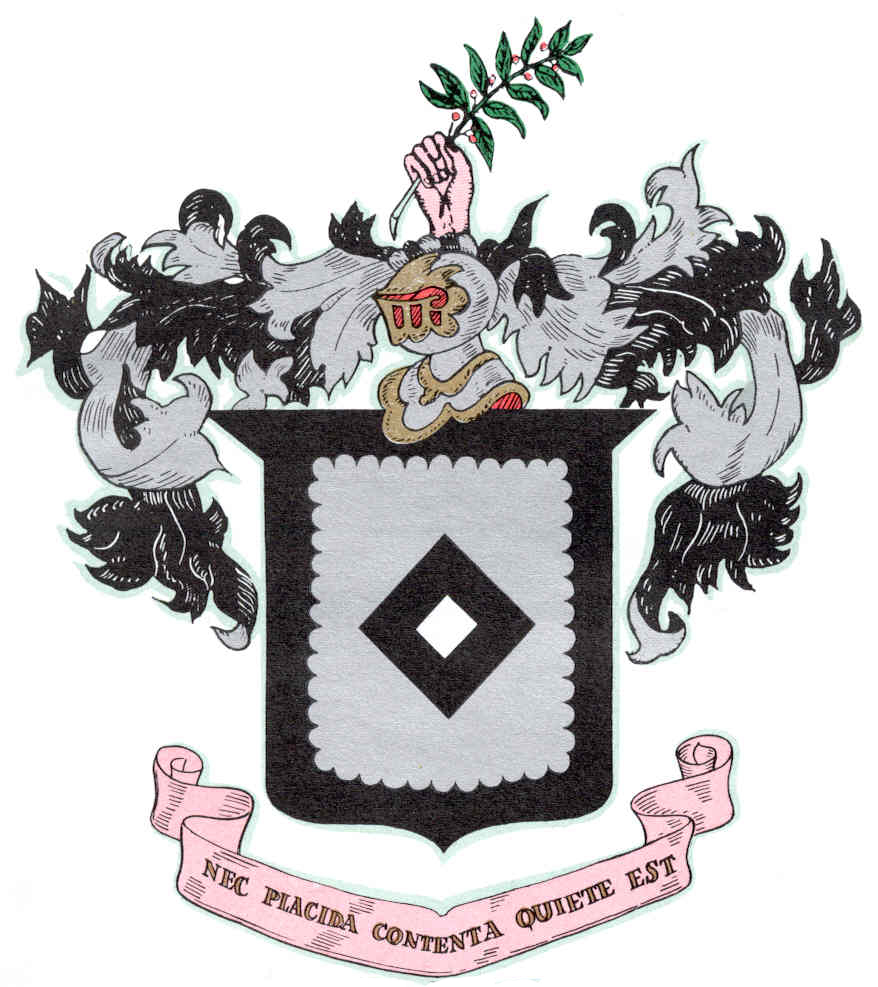
According to the best authorities, the English name "Shipley" is of Anglo-Saxon origin.
The name “Shipley” is a combination of two words. The first is derived from the Old English word "scīp" (meaning sheep), a Northumbrian dialect form, which morphed into the Anglian form "scēp" to become the modern English word sheep. The second comes from the Old English "lēah", meaning a forest, wood, glade, or clearing and, later, meaning a pasture or meadow.1 It has been defined in various publications as “forest clearing used for sheep,” “sheep field,” “sheep pasture,” and “sheep wood/clearing2.”
As early as 1086, it was recorded as Scipelei/Scipeleia/Scipelie in King William the Conqueror’s “Great Survey” of property in England, referred to as the Domesday Book3. Since then, it has been spelled in various manners throughout numerous records—Schippeley (1287), Schepelay (1328), Shepley (1523), and Shipley (1554)4, to name a few.
References
- The Cambridge Dictionary of English Place-Names Based on the Collections of the English Place-Name Society, ed. by Victor Watts (Cambridge: Cambridge University Press, 2004); and Mills, A. D., 1991, revised 2011, A Dictionary and English Place-Names, Oxford, OUP, p.417
- “Key To English Place Names.” University of Nottingham. Retrieved 4 March 2025. http://kepn.nottingham.ac.uk/map/place/Yorkshire WR/Shipley
- “The Domesday Book Online.” Retrieved 4 March 2025. https://www.domesdaybook.co.uk/
- Armitage Goodall, Place Names of South West Yorkshire
Research into Adam Shipley's English roots conducted by Dr. Neal Shipley, Department of History, University of Massachusetts at Amherst, also provided information on the origins of the Shipley name. He presented his findings at the Shipleys of Maryland Annual Meeting, October 1993. The following is extracted from his presentation. (see his full report here)
...it looks as though the family name originates in the late 12th century in a corner of Yorkshire, in the vicinity of Huddersfield and Wakefield, and that it was chosen by the first Adam Shipley. He wanted to distinguish one of his sons as specifically a Shipley. We can see his descendants well down into the 13th century -- into the reigns of John I and Henry III -- when they were very well-known and leave loads of records. After this, the family ramifies out in every direction. Within a hundred and fifty years you find Shipleys dense on the ground in this area -- so dense, so thickly settled, that they occupy practically every niche on the social scale. Most of them tend to be farmers or what we would call "franklins", which is to say small, prosperous, independent farmers or "yeomen" types. Many of them were landowners, and there was a heavy concentration of clergymen in the family.
...I think I probably found the first person who took the name Shipley as a surname. It goes back a very great distance. In the year 1180 approximately, there was an individual living in the West Riding of Yorkshire, (where else) who had the Christian name of Adam. The name seems to be continuous. But now this is the period in which people do not, as a rule, have surnames yet, because they have not come into common use. You are identified by different things: who your father was, where you live, what you do, or by some physical feature. So Adam was known as Adam, son of Roger of Barnsley. He was also known as Adam, the Steward, because he was steward of the Manor of Barnsley. He was also known as Adam Oldfield, which is a place name. And he was known as Adam of Shepley, because that too is a place name...
...Adam, who had all these names, had four children, and here is where it gets very specific. He had three sons and a daughter. The daughter married very well. An indication: she became Lady Craven, marrying Baron Craven of an old Yorkshire noble family. They survived on to the 18th century. But he had three sons, and to each he gave a different surname. This was the point at which people in England realized that you really had to have a surname to make it. And he gave each of them a different name. The oldest son was named John and his descendants carried the name John of Oldfield. His youngest son was Hugh, and he was named Hugh of Baghill. His descendants, the Baghills, did not last very long. I have never been able to find Baghill -- nobody has. But the second son was Robert, and he was given the name Robert Shepley. That is all he was ever known as. It looks very clearly as if the three sons were differentiated so that their inheritances would not be confused. There was John of Oldfield, Robert of Shepley and Hugh of Baghill. Descendance here is a little bit difficult to trace exactly, but it is significant, I think, that we are talking around the 1180's to the 1190's...